
99 Tiny Games in London

Photo via Pop Up City
%20%2F%2F%20The%20Accessible%20City "Pin It")
Photo via Pop Up City
%20%2F%2F%20The%20Accessible%20City "Pin It")
Pop Up Swings
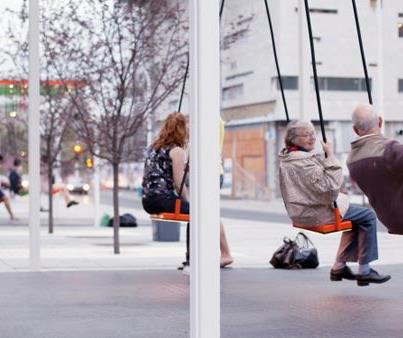
Pop Up Swings in London. Photo via Sustainable Cities Collective.

Today I found this image of “Pop Up Swings” installed near bus stop in London. This swing set was designed up industrial design student Bruno Taylor who says: “This project is a study into different ways of bringing play back into public space. It focuses on ways of incorporating incidental play in the public realm by not so much as having separate play equipment that dictates the users but by using existing furniture and architectural elements that indicate playful behaviour for all.”
Similar projects have popped up around the globe (including the more formalized The Red Swing Project) and all tap in to similar ideas. The great thing about installing these delightful swings at a bus stop is that they can help to activate a drab public space by introducing playfulness and they also function as an incentive to ride pubic transportation.
How? Well, you know the expression “time flies when you’re having fun”? Having a joyful activity like to Pop Up Swings to watch or participate in while waiting for the bus will make your wait time seem shorter and shorter wait times incentivize the use of public transportation because the wait will not feel as burdensome (especially if you are accompanied by children, seniors or are carrying a heavy load) and makes the experience of waiting for public transportation less intimidating.
Cultural Humility Versus Cultural Competency
Health professionals Melanie Tervalon and Jann Murray-Garcia were looking critically at the idea of “cultural competency” and felt that these types of examples were reflective of a choice of an individual and not necessarily the choices of a larger group. They determined that it is not only important to understand that cultural norms exist but it is also important not to believe we could ever achieve “competency” in the understanding of a particular group of people because every individual is more than just a list of traits.
They also advocate for all professionals who work with community to be humble by never being afraid to ask questions because each one of us is a complicated, multi-dimensional human being. Asking questions does not take away from your intelligence, is a sign of respect and only benefits our understanding. And relationships of mutual respect will always be the most reciprocal.
It is my view that the role of an urban planner is to help facilitate the needs and wishes of a community (the experts of the area in which they live), and although the tenants of Cultural Humility were designed to influence more respectful and informed decision-making within the medical profession, I believe Cultural Humility is essential in achieving this goal.
You can watch a 30-minute documentary about Cultural Humility “Cultural Humility: People, Principles and Practices” by San Francisco State Professor Vivian Chávez here.
East LA’s Fresh Food Advocates
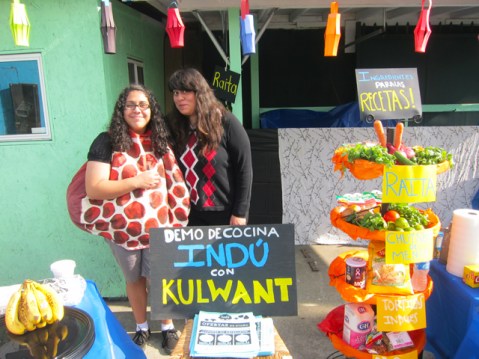
Fresh food advocate Clara Mejia (right) and her classmate Catherine Martinez.
Some of us are lucky enough to live in a neighborhood where we can find fresh fruits and vegetables and other healthy food options within a short car ride or walking distance from our homes. For those who live in a “food desert” (and especially those who do not have a car or access to reliable public transportation) the options are usually limited to fast food restaurants, street food, 99 cent stores, liquor stores and inadequate local corner markets; and options can have a huge impact on a neighborhood’s health.
Local East Los Angeles resident, Clara Mejia understands what it’s like to live in a food desert. “In East L.A. it’s cheaper and easier to buy four fast food hamburgers than to cook a healthy meal at home,” she said. “There just aren’t many options for healthy food here.” Clara describes a food desert as “a place that has a lack of access to healthy produce and mainstream grocery stores”. East Los Angeles residents have suffered from the lack of accessible food options in their community by having some of the high rates of obesity, heart disease, hypertension and stroke in Los Angeles County.
Clara and her classmates at East L.A. Renaissance Academy (ELARA), School of Urban Planning and Design are learning how to change this paradigm by thinking critically about food justice and how to an active agent of change their community. In 2010, ELARA partnered with Public Matters (LINK) and the UCLA-USC Center for Population Health and Health Disparities to increase access and consumption of healthy foods among Latino’s in East L.A by transforming four corner stores into venues with healthier food options.The program called “Proyecto MercadoFresco del Este de Los Angeles” is part of a five-year long initiative tilted “Family and Neighborhood Interventions to Reduce Heart Disease Risk in East L.A.”
ELARA students have been working with Public Matters to learn about the negative impact of food deserts on public health and how to use social marketing, media (check out their amazing video below!) and community engagement to become advocates for healthy food options. Last Summer, Clara and her classmates helped to transform Yash la Casa Corner Market with facade treatments, refrigeration upgrades, a community garden and multi-cultural cooking classes demonstrating affordable meals options. Clara says: “After we started the project, Kulwant, the store owner, asked if we could build a garden. A total of 26 students broke the concrete in the back of the store, brought in soil and plants, and painted the walls with stencils and silhouettes of fruits and vegetables”. The transformation of the market really became a community event and helped bring those involved closer together around these issues.
When she began her classes with Public Matters, Clara she had no idea how transformative the classes would be. “We even planted our own garden at home, including apples, peaches, tomatoes, beets, carrots, lettuce, squash, broccoli, and zucchini.” As Clara points out, the root of the issue is about having access: “People in East L.A. would eat healthier if they had options for buying healthy food.”
Have You Noticed How Often You Eat Fast Food? from Public Matters on Vimeo.
Pacoima’s Mural Mile

Levi Ponce with his painting called “Pacoima’s Art Revolution . Photo by April Aguirre via KCET Departures.

April Aguirre of the blog I Am San Fernando has declared that a portion of Van Nuys Blvd (between San Fernando Road and Foothill Blvd) to become Mural Mile. These murals are projects born of passion, love and pride for community and create a connection between the residents and their community.

“Ritchie Valens” by Manny Velazquez. Photo by April Aguirre via KCET Departures.

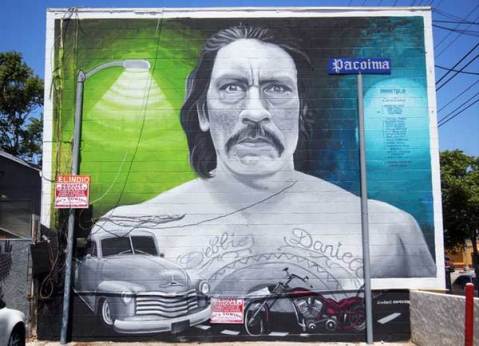
“Danny Trejo” by Levi Ponce. Photo by April Aguirre via KCET Departures


 THE ACCESSIBLE CITY