
German Garbagemen Turn a Giant Lens on Their City
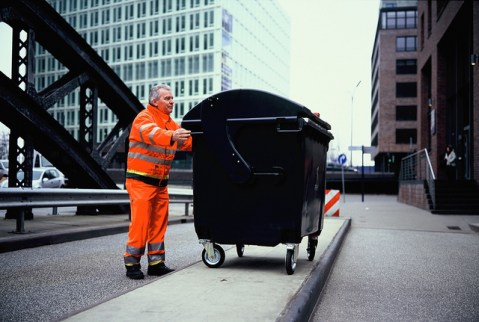
Garbageman Hans-Dieter Braatz sets up a photo with a pinhole camera fashioned out of a garbage dumpster. Photo by Mirko Derpmann


The Hamburg fun fair photographed with a trash dumpster pinhole camera. Photo by Bernd Leguttky, Christoph Blaschke and Mirko Derpmann


The Marco Polo Tower in Hamburg, Germany, photographed with a trash dumpster pinhole camera. Photo by Michael Pfohlmann, Christoph Blaschke and Mirko Derpmann

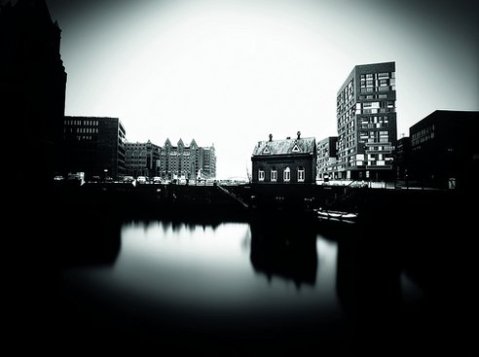
The Fleetschloss in Hamburg, Germany, photgraphed with a trash dumpster pinhole camera. Photo by Hans-Dieter Braatz, Christoph Blaschke and Mirko Derpmann via Treehugger

Los Angeles’ Street Pianos
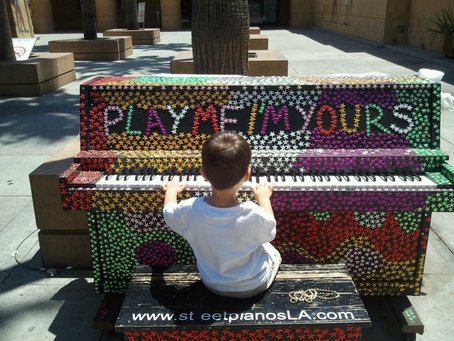
Future pianist plays at a street piano near the Egyptian Theater. Photo by Adam Winter via streetpianos.com

Between April 12th and May 3rd, 30 pianos were scattered around Los Angeles for anyone to play and enjoy. The project called “Play Me, I’m Yours” was the brainchild of Luke Jerram who has installed more than 600 pianos in 26 cities across the country in the last four years. In Los Angeles, the Los Angeles Chamber Orchestra teamed up with local artists and community groups to decorate pianos and work with Mr. Jerram to bring the project to life and the Street Pianos website became a repository for images and videos of professionals and those not-so-professional to share their experiences with the pianos.
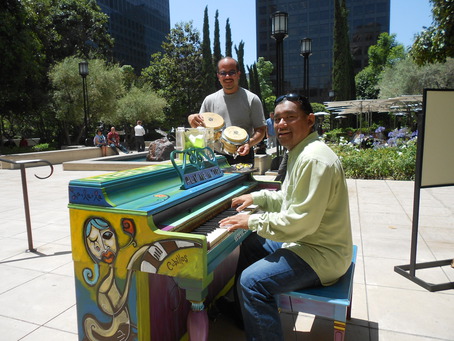
Musicians having fun at a street piano in Los Angeles. Photo by Elson Trinidad via streetpianos.com

Mr. Jerram says that the “idea for Play Me, I’m Yours came from visiting my local launderette. I saw the same people there each weekend and yet no one talked to one another. I suddenly realised that within a city, there must be hundreds of these invisible communities, regularly spending time with one another in silence. Placing a piano into the space was my solution to this problem, acting as a catalyst for conversation and changing the dynamics of a space.”
These pianos were a true delight in our city. Helping to create livelier indoor and outdoor spaces and bring passersby together to stop and enjoy beautiful executions of music as they unfolded.
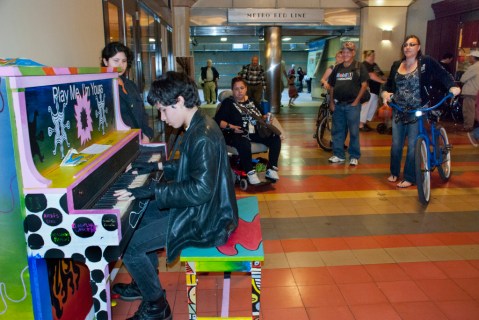
People gather to watch a musician at Union Station in Los Angeles. Photo by The MetroDuo Blog

Designing for the Deaf
For people who are deaf or hard of hearing, certain environments can be a deterrent to communication and hinder navigation. For deaf people, vision and touch provide spatial awareness and orientation, and lighting clear sight lines (within buildings and shared space) can aid visual communication and wayfinding.
Gallaudet University in Washington, D.C, America’s leading institute for higher education for the deaf and hard of hearing has issued “DeafSpace Guidelines” which address the ways in which deaf people have altered their surroundings to better suit their needs and design strategies we can implement going forward that address these issues. According to Gallaudet: “When deaf people congregate the group customarily works together to rearrange furnishings into a “conversation circle” to allow clear sight lines so everyone can participate in the visual conversation. Gatherings often begin with participants adjusting window shades, lighting and seating to optimize conditions for visual communication that minimize eyestrain. Deaf homeowners often cut new openings in walls, place mirrors and lights in strategic locations to extend their sensory awareness and maintain visual connection between family members.”
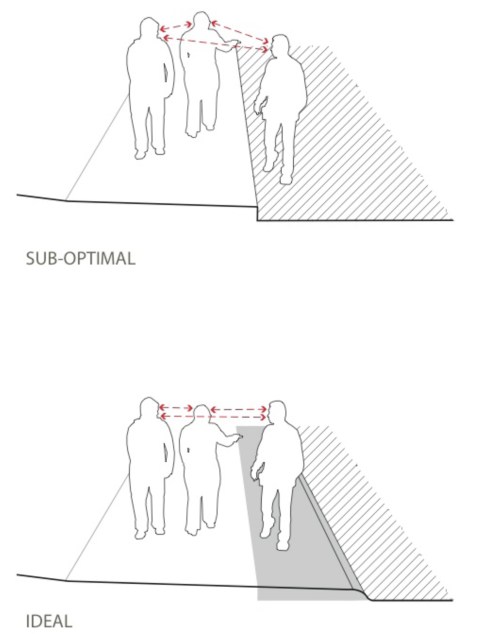
Graphic showing space needed for optimal visual communication. Via Atlantic Cities

In 2005, Hansel Bauman, the director of campus design and planning at Gallaudet University, worked with faculty, students, and staff to research the behavior of deaf people within their environments. From this research, the DeafSpace guidelines emerged which now consist of over 150 DeafSpace design elements that address the major issues between the deaf experience and their physical environment including sensory experiences, mobility, promexics (use of space within interpersonal communication), light and color and acoustics change the behavior of deaf people within their environments. These design improvements have been implemented across the Gallaudet campus including within five residence halls (and another under construction) and the Sorenson Language and Communication Center. Bauman has found all of these issues essentially touch upon how to build community, embrace visual language and promote personal safety and well-being. Robert Sirvage, a Gallaudet professors says “DeafSpace really is about bringing a new perspective to the meaning of good design.”
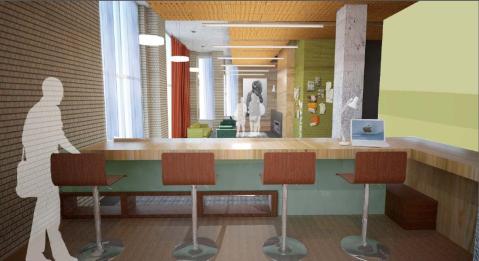
A computer rendering of a room designed by DeafSpace design principles. Photo by Studio Twenty Seven Architecture via Atlantic Cities


The Sorenson Language and Communication Center designed with DeafSpace design principles. Photo by Gallaudet University via Atlantic Cities

The Transfer Accelerator!
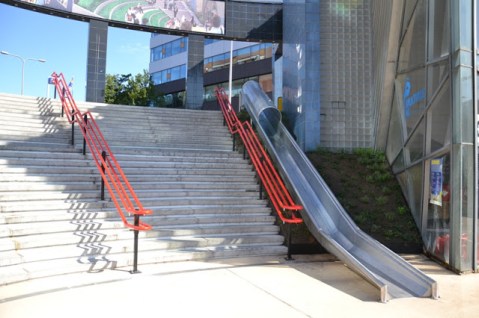
The Dutch city of Utrecht’s “Transfer Accelerator”. Photo via Pop Up City.

The Dutch city of Utrecht has installed a slide (or what they humorously call a “Transfer Accelerator”) at a local subway station. Often we talk about successful public space project “activating” spaces and this happens through movement, engagement and conversation and this slide accomplishes all three. How fun! And what a wonderful way to spend time waiting for a train or to slide your luggage instead of carrying it down those stairs. = )
Watch a video about the Transfer Accelerator below:
Ovarian-Psycos Bicycle Brigade
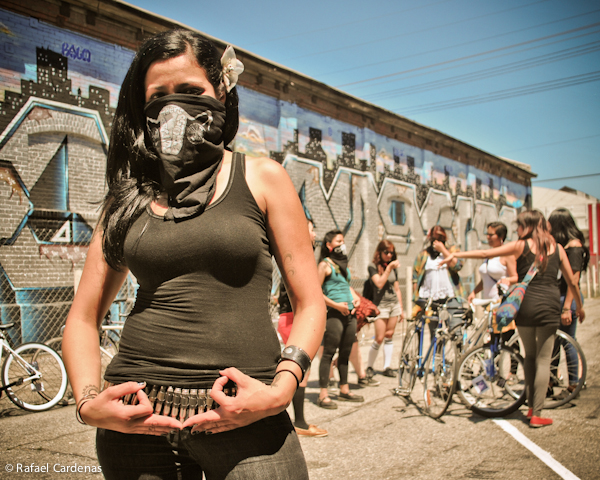
Xela de la X shows the Ova’s signature sign. Photo by Rafael Cardenas via EastsiderWriter.com

While studying urban planning in graduate school I became fascinated with the sociology of public space. Why were some paces used more than others and why were some spaces perceived to be inclusive or exclusive by certain populations. During an internship in the New York City Department of Transportations innovative Office of Public Spaces, I began to understand that our streets were actually our largest public spaces and through public plazas for example, they had the ability to be transformed in to spaces that prioritized pedestrians instead of cars.
For my master’s thesis, I merged my interest in public space analysis, transportation planning and women’s studies by looking at what deters women to ride bicycles in New York City. Not unsurprisingly, motorist aggression and fear of personal safety were the greatest deterring factors for women but what surprised me were the limited opportunities encouraging those unfamiliar with riding a bicycle and the lack of attention to the needs of a wide variety of users in the design of our cycling infrastructure and facilities.
In spite of the ground that women have gained in the fight for equal rights, studies have show that women are more likely to run household errands and transport children and elderly family members. For some women, this can make their travel behavior and willingness to take risks different from that of a single rider traveling from Point A to Point B. Often, I look for examples of thoughtful cycling infrastructure and the encouragement of bicycling to a wide variety of users (specifically women) so today I was ecstatic to read about the Ovarian-Pyscos, an East Los Angeles bicycle collective, in Los Angeles Streetsblog.
The Ovarian-Psycos Bicycle Brigade, an all-women bicycle collective from East Los Angeles, is not only supporting one another in cycling through the city and raising awareness about cyclists, they have become a powerful collective supporting women’s rights, social justice and each other.
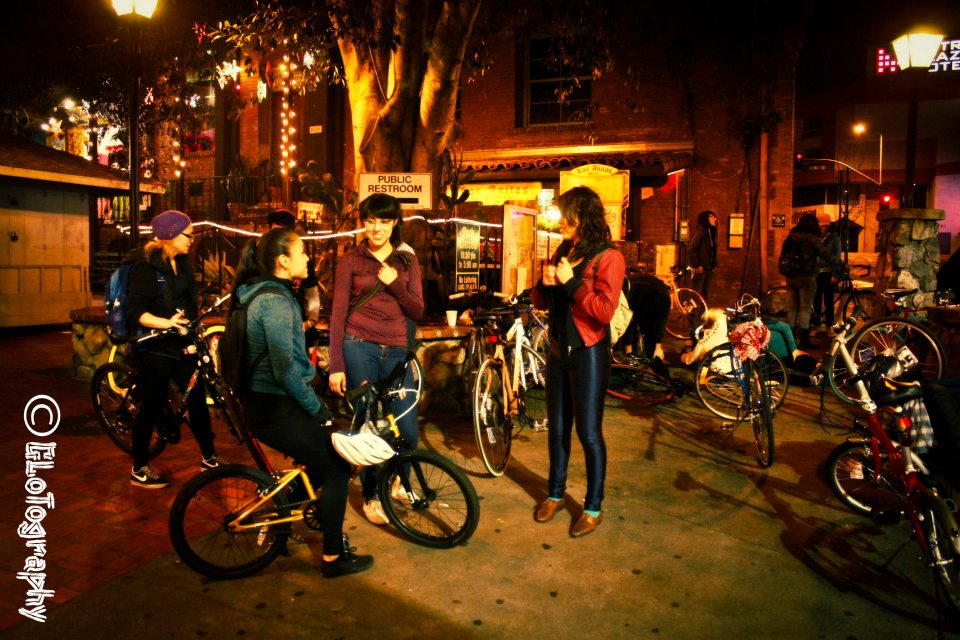
The Ova’s gather before their Take Back the Night Ride. Photo by GLoTography via Streetsblog
%20%2F%2F%20The%20Accessible%20City "Pin It")
From Los Angeles Streetsblog:
“Two months ago, when 22-year-old Bree’Anna Guzman was murdered in Lincoln Heights, the all-women bike group Ovarian-Pscyos Bicycle Brigade scrapped their previously planned ride to ride instead through the neighborhood to protest the killing.
‘Whose Streets,’ one woman called out.
‘Our Streets’ the more than 30 women riding answered.”
“Many of the women say they feel they are not taken seriously in the biking community because their rides aren’t as long as traditional rides, there are usually many first-time riders, and the ride will stop and wait for one person. But, these limitations, Ova member Natalie Fraire said, can be a positive.
‘We are encouraging a lot more riders and that’s more important, said Fraire.”

 THE ACCESSIBLE CITY