
Beyond Zuccotti Park
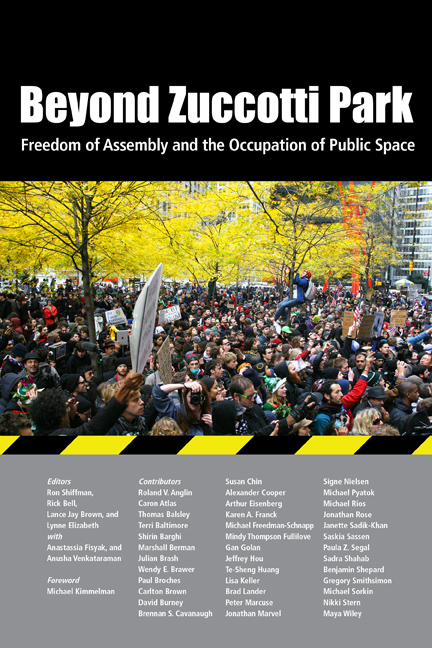
Beyond Zuccotti Park: Freedom of Assembly and the Occupation of Public Space from New Village Press

During the Occupy movement, one of the most important questions asked was who owns our public spaces and what is the role of these spaces and who is allowed (or deterred) from speaking? Beyond Zuccotti Park: Freedom of Assembly and the Occupation of Public Space is a new book that asks: Where can the public congregate and how can city planning, design, and policies support First Amendment rights to public assembly and free speech? The book features essays written by experts in social science, planning, design, civil liberties, urban affairs, and the arts that address the importance of our public spaces as forums for expression with an historic and contemporary lens.
I’m proud to say that many professors, current students and alumni of my alma mater Pratt Institute contributed to this thoughtful and important book. You can read more about the book (and it’s larger initiatives, current exhibitions, lectures and news) through Beyond Zuccotti Park’s Twitter and Facebook pages.
The Skateboarding Girls of Kabul
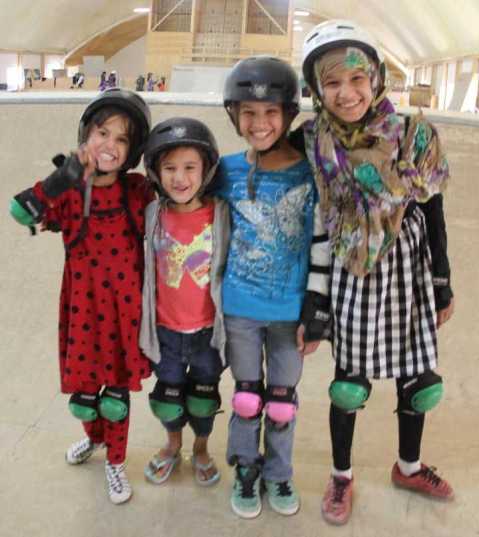
Skateistan students Tamima, Fatima, Gulmina, and Suhaila. Photo via Skateistan

Get ready. A skateboarding revolution is happening amongst young girls… in Afghanistan.
In 2009, Skateistan (an NGO and Afghanistan’s first skateboarding school) opened the doors to it’s 5428 square meter facility in Kabul, providing recreational sports and education and creative arts classes to boys and girls ages 5-17. According to Skateistan, 60% of Afghanistan’s population is under 25 and 50% is under the age of 17. Children without education (an especially girls – only 12% of Afghan women are literate) have few opportunities open to them. Skateistan aims to provide children with a safe place for education and recreation and hopes to instill each one of their students with confidence, team work and leadership skills, to help them become empowered individuals who affect change in their community.
Each week, Skateistan welcomes over 400 children, half of who are children streetworking children, some are refugees, some are disabled and 40% of all the children are girls. To help make the facility more accessible, Skateistan provides transportation to and from the facility (women and girls are usually not allowed to travel alone and getting around Kabul can be difficult with traffic congestion, limited public transportation and street harassment) as well as skateboards, other sports equipment, safety gear and educational materials.
Afghanistan’s Girl Skaters – Kabul 2012 from Skateistan on Vimeo.
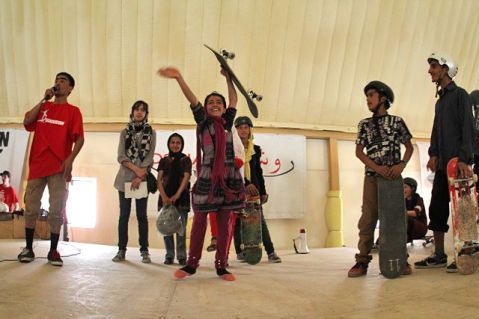
Tamana, 11 wins 1st place in the girl’s skateboarding contest. Photo via Skateistan

Crosswalk Performance Art in Paris
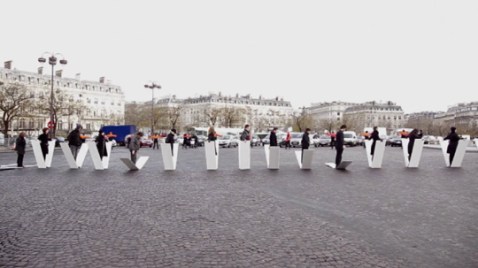
Pop Up Crosswalk by X/TNT in Paris, France. Photo via Pop Up City

French theater group X/TNT wanted to raise awareness about the dangerous conditions that exist for pedestrians at La Place de L’Etoile (the roundabout under the Arc de Triomphe) in Paris. Check out their performance, creating a temporary street level crossing (the city prefers pedestrians access the Arc via an underground pedestrian tunnel) to get from one side of the street to another.
STRESS FREE – La prise de l’étoile – Pedestrian crosswalk from Xtnt – Urban Theater on Vimeo.
East LA’s Fresh Food Advocates
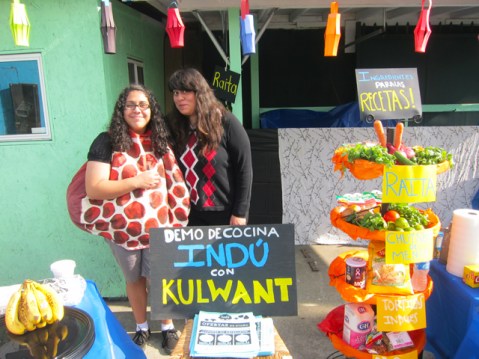
Fresh food advocate Clara Mejia (right) and her classmate Catherine Martinez.
Some of us are lucky enough to live in a neighborhood where we can find fresh fruits and vegetables and other healthy food options within a short car ride or walking distance from our homes. For those who live in a “food desert” (and especially those who do not have a car or access to reliable public transportation) the options are usually limited to fast food restaurants, street food, 99 cent stores, liquor stores and inadequate local corner markets; and options can have a huge impact on a neighborhood’s health.
Local East Los Angeles resident, Clara Mejia understands what it’s like to live in a food desert. “In East L.A. it’s cheaper and easier to buy four fast food hamburgers than to cook a healthy meal at home,” she said. “There just aren’t many options for healthy food here.” Clara describes a food desert as “a place that has a lack of access to healthy produce and mainstream grocery stores”. East Los Angeles residents have suffered from the lack of accessible food options in their community by having some of the high rates of obesity, heart disease, hypertension and stroke in Los Angeles County.
Clara and her classmates at East L.A. Renaissance Academy (ELARA), School of Urban Planning and Design are learning how to change this paradigm by thinking critically about food justice and how to an active agent of change their community. In 2010, ELARA partnered with Public Matters (LINK) and the UCLA-USC Center for Population Health and Health Disparities to increase access and consumption of healthy foods among Latino’s in East L.A by transforming four corner stores into venues with healthier food options.The program called “Proyecto MercadoFresco del Este de Los Angeles” is part of a five-year long initiative tilted “Family and Neighborhood Interventions to Reduce Heart Disease Risk in East L.A.”
ELARA students have been working with Public Matters to learn about the negative impact of food deserts on public health and how to use social marketing, media (check out their amazing video below!) and community engagement to become advocates for healthy food options. Last Summer, Clara and her classmates helped to transform Yash la Casa Corner Market with facade treatments, refrigeration upgrades, a community garden and multi-cultural cooking classes demonstrating affordable meals options. Clara says: “After we started the project, Kulwant, the store owner, asked if we could build a garden. A total of 26 students broke the concrete in the back of the store, brought in soil and plants, and painted the walls with stencils and silhouettes of fruits and vegetables”. The transformation of the market really became a community event and helped bring those involved closer together around these issues.
When she began her classes with Public Matters, Clara she had no idea how transformative the classes would be. “We even planted our own garden at home, including apples, peaches, tomatoes, beets, carrots, lettuce, squash, broccoli, and zucchini.” As Clara points out, the root of the issue is about having access: “People in East L.A. would eat healthier if they had options for buying healthy food.”
Have You Noticed How Often You Eat Fast Food? from Public Matters on Vimeo.
Kansas City Residents Build Their Own Bike Sharing Network
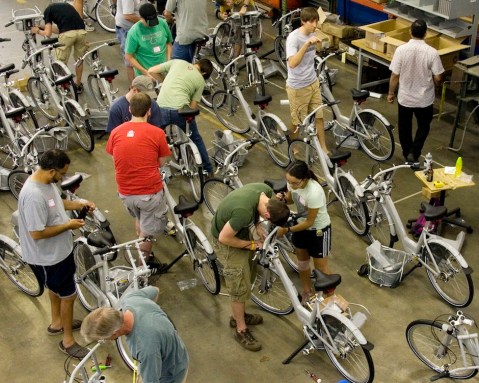
Kansas City residents build their own bike sharing network. Photo via This Big City

Kansas City, Missouri has the highest ration of highway miles to city population in the country and also ranks last in bicycle and public transportation ridership in the nation. BikeWalkKC, a local bicycle advocacy group takes the approach, that if you don’t have the bicycle infrastructure you want, you build it yourself and they are asked local volunteers to help build a new bike sharing system for their city.
Volunteer labor not only reduces operational costs for the organization, but more important, BikeWalkKC is hoping that volunteers will become invested in the system they build and in turn, become advocates themselves.
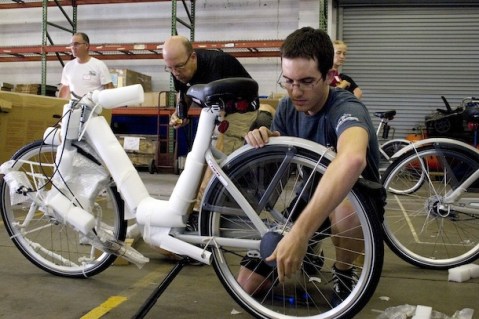
Kansas City residents build their own bike sharing network. Photo via This Big City

Over a two-day period and with the support of local business and Blue Cross Blue Shield of Kansas City, 75 dedicated volunteers assembled NINETY bikes for the new bike share system. The bikes will be ready for Kansas city on July 3rd and spread from the Market District to the north and the downtown areas of Union Station and Crown Center to the south.
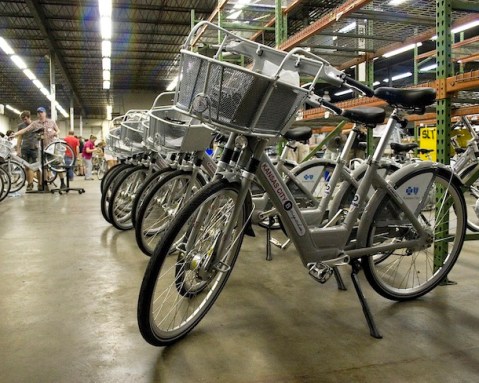
Kansas City residents build their own bike sharing network. Photo via This Big City


 THE ACCESSIBLE CITY